

For most local service businesses, the answer is: a fast, clear website comes first, and a blog comes second. A plumber, dentist, roofer or salon in Cincinnati gets found when the site has strong service pages, a well-kept Google Business Profile and a steady stream of reviews. A blog can then add to that foundation, but it cannot stand in for it. If you are deciding where your next hour and your next dollar should go, start with the pieces that bring in calls, and add a blog when you have real answers worth publishing.
We build hand-coded websites for Cincinnati businesses at $99 a month with unlimited content updates, so a blog section can be added any time you are ready. Below is how to decide, what to publish first and how to keep a blog from turning into a chore.
TL;DR
- A blog is a section of your website where you publish articles. It is not a separate site and not a requirement for being found locally.
- For local searches, Google weighs proximity, relevance and prominence, and your Google Business Profile does most of the work. A blog only supports it.
- Build service pages, a complete Business Profile and a review routine first. Add a blog once those are working.
- If you blog, publish useful, local, specific posts on a schedule you can keep. A neglected blog hurts more than no blog.
- Skip the blog if you have nothing to teach, no time to maintain it, or a business where customers choose on convenience alone.
Table of Contents
- What a blog is, and what it is not
- Do people still read blogs?
- How blog posts fit into local search
- When a blog is worth it
- When you can skip the blog
- What to do instead, or first
- How to run a small business blog without it eating your week
- What a blog costs you
- Where we come in
- Our view
- FAQ
- Sources
What a blog is, and what it is not
Three terms get mixed up. A website is the collection of connected pages under your domain: home, services, about, contact. A blog is one section of that website where articles are published and organized, usually newest first. A blog post is a single article in it. A business blog is almost always part of the company site rather than a standalone property.
That matters because the question is rarely "blog or no blog" in the abstract. The real question is where your limited effort earns the most. A blog is one option among several: service pages, a Business Profile, reviews, email to past customers and social media all compete for the same hours.
Do people still read blogs?
Yes, though not everyone and not all the time. Search Engine Land's roundup of blogging statistics reports that 84% of B2C marketers used blogs on their corporate sites to distribute content over the past year, and that roughly 83% of internet users read blogs at least monthly, citing HubSpot. The Better Business Bureau, citing the annual Orbit Media survey, notes that 80% of bloggers report that blogging drives results.
Two cautions keep these numbers honest. First, they come from people who blog and from marketers, so they describe a self-selected group. Second, readership is not the same as customers. A local homeowner searching for a water heater installer in Cincinnati rarely wants to read a feed. They want a page that says you do the job, serve their area and have happy customers.
The better way to think about a blog today is as a library of answers. People type questions into Google and AI assistants before they buy. A post that answers one of those questions clearly can bring the right person to your site months later.
How blog posts fit into local search
Local results are not decided the way national results are. Search Engine Land's local SEO guide explains that local SEO suits businesses serving customers face to face, either at their location or at the customer's, and that a Google Business Profile requires a physical address and in-person service. For a business like that, the profile and the on-site pages carry the weight.
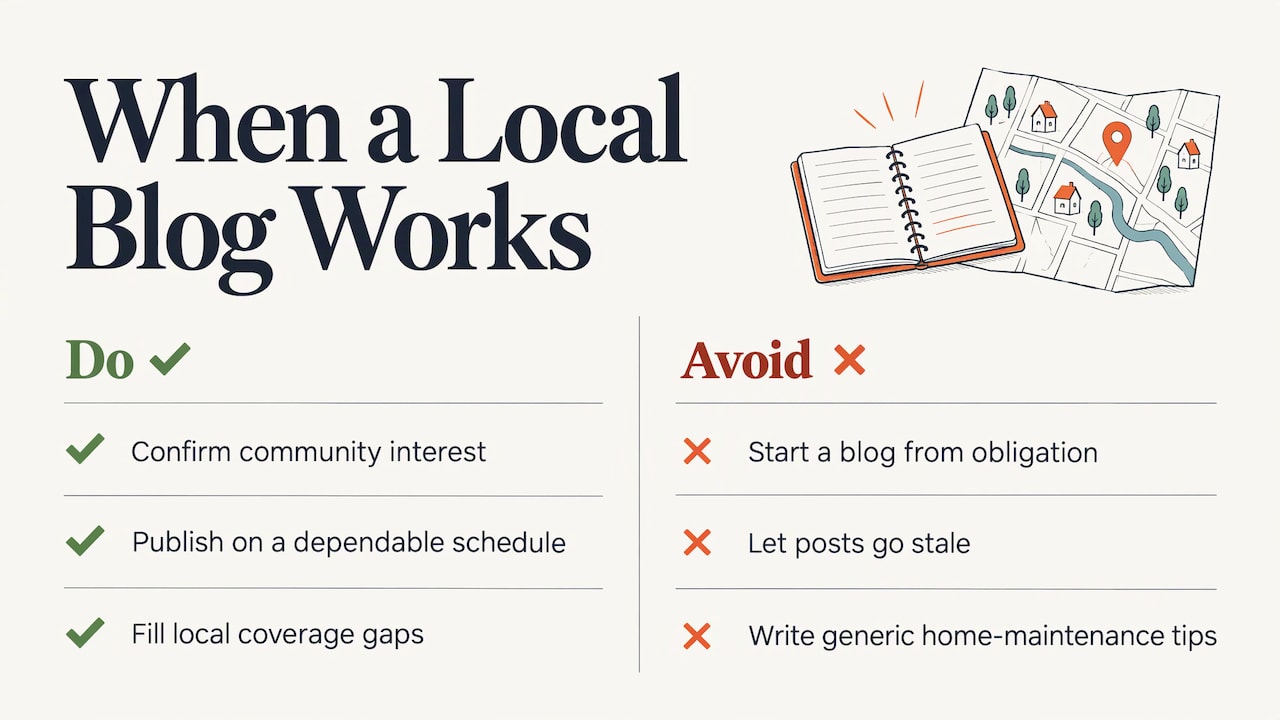
The same guide is direct about blogs. A hyperlocal blog can help organic rankings when three things are true: there is enough community interest, you can publish on a dependable schedule, and the community lacks local coverage. It also warns that local brands that start blogs out of obligation and let them go stale create the impression that the business is neglecting its online presence.
Translate that to Cincinnati. A post about how Over-the-Rhine's older buildings affect HVAC replacement, or what a Hamilton County permit involves for a deck, is the kind of local knowledge that few national sites offer. A post titled "5 Tips for Maintaining Your Home" is not.
If you want a closer look at how local content supports visibility beyond your own city, this guide on SEO for real estate agencies shows how a local business can plan content around the searches its clients actually make.
The things that come before a blog
If your site is slow, hard to use on a phone, or missing a page for each service you sell, a blog will not fix that. Our guide on 11 website page checks local businesses should fix first covers the on-page basics. Your Business Profile deserves the same attention, and 8 first moves for busy local owners is a practical starting list. Citations, the consistent listings of your name, address and phone number across the web, are covered in our citations guide.
Only after these are in place does a blog start to earn its keep, because posts then have a strong site to send visitors to.
When a blog is worth it
A blog pays off in specific situations. Check yourself against these.
Your customers research before they call
If the job is expensive, rare or confusing, people read first. Kitchen remodels, estate planning, HVAC replacement, dental implants and tax help all fit. Each question a customer asks you on the phone is a post waiting to be written. Answer it once on your site, and you stop repeating it forever.
You have local expertise others lack
Service-area guides, local rules, seasonal advice for Ohio weather and neighborhood-specific knowledge are things a generic national article cannot copy. That is the content that earns trust with someone who lives ten minutes from you.
You can keep a schedule
The BBB suggests starting with a routine of once a week or twice a month. Pick the lower end. One good post a month is twelve useful answers a year. A burst of ten posts followed by a year of silence is worse than a short, steady record.
Your site has thin content
If your pages say very little, adding substantive articles gives search engines and customers more to work with. In that case, first make the service pages themselves fuller, then add posts.
When you can skip the blog
Some businesses gain little from one. Where customers decide on location and convenience, such as a gas station, a coffee counter or a drive-through, nobody reads an article before choosing. If you are a solo operator with no time to write and no questions customers keep asking, your hours do more work elsewhere.
Skipping the blog does not mean skipping content. A page for each service, a page explaining your pricing approach and a clear FAQ on the service page itself are content too, and they match what people searching for a provider are looking for.
What to do instead, or first
Here is the order that fits most Cincinnati service businesses.
- A fast, mobile-friendly site with one page per service. Most local searches happen on phones. Each service page should say what you do, where you do it, what it costs or how pricing works, and how to reach you.
- A complete Google Business Profile. Categories, hours, service areas, photos, services and regular posts. Our Local SEO Cincinnati playbook walks through how these pieces connect.
- A review routine. New reviews tell Google and customers that you are active. Asking every happy customer at the right moment is the habit that matters, and automating the request keeps it from slipping.
- Keyword research for your area. Before writing anything, learn which phrases people use. Our local keyword research guide shows a step-by-step method for small businesses.
- Measurement. Know which pages bring calls and what to track. See what to track in local SEO reporting.
- Then the blog. With steps one to five running, each post has somewhere to send readers and a way to be measured.
How to run a small business blog without it eating your week
If you decide to blog, the BBB lists the usual roadblocks: setting up the blog feature, finding the time, deciding on post length and dealing with outdated content that should be refreshed or deleted. A workable approach:
- Start with questions. List the ten questions customers ask most. Each becomes a post.
- Make each post substantive. One thorough post beats several thin ones. Write for a person, not for a keyword.
- Keep it local. Name the neighborhoods, the local rules, the seasonal conditions. Real specifics are what separate your post from every generic one.
- Link to your service pages. Every post should lead a reader to the next step: a service, a quote form or a phone number.
- Review old posts twice a year. Update prices, rules and dates, or remove what no longer applies.
- Set a cadence you can keep for a year. Monthly is enough for most small teams.
There is a useful side benefit. Because Google Business Profile posts are a separate, quick format, short updates there keep your profile active between longer articles.
What a blog costs you
The cost is mostly time. Each post means choosing a topic, writing, checking facts, adding photos and publishing. For a business owner already on the job all day, a monthly post is realistic and a weekly one often is not. Decide before you start who writes, who approves and when it happens, and put it on the calendar like any appointment.
On the website side, the hosting platform is rarely the barrier. The BBB points out the blog feature is included in most major site platforms. What matters is that your site lets you add and change content easily, and that updates are not billed one by one.
Where we come in
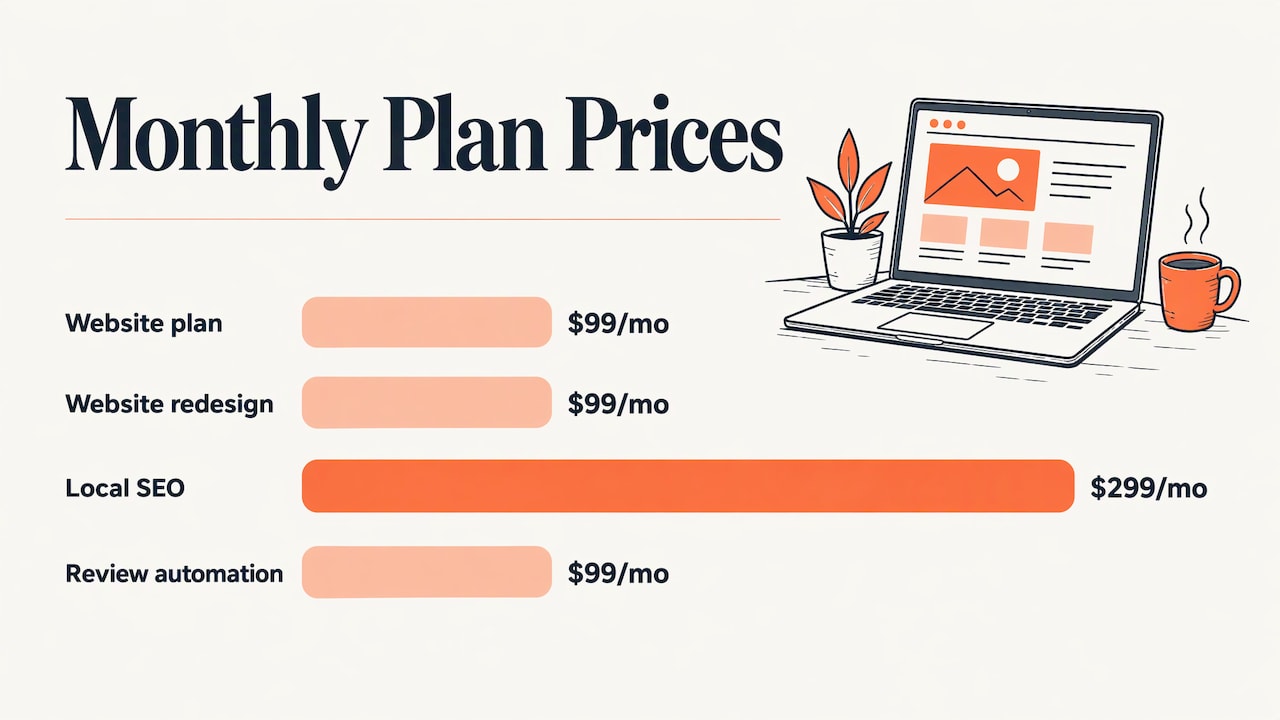
Our Website plan is $99 a month with no upfront cost. Sites are hand-coded rather than built from themes or page builders, are mobile-responsive and fast, and include hosting, SSL, your domain, maintenance and unlimited content updates. That means adding a service page, changing a price or publishing a new article is part of the plan, not an extra invoice.
If your current site is the weak link, our website redesign is also $99 a month. For the visibility side, our Local SEO plan is $299 a month and covers Google Business Profile management, citation building and on-page optimization. Google Review Automation is $99 a month. Most of our offerings run on a 12-month agreement.

If you want the foundation in place before you think about a blog, see the pricing page for the Website, Review Automation and Local SEO plans, or read how our Google Business Profile management works.
Our view
Almost every owner who asks us about blogging is really asking whether they are doing enough online. Usually the honest answer is that the basics are not finished yet.
We build every site by hand because a site should be fast, clear and easy to change. When the pages that sell your services are sharp, and your profile and reviews are doing their job, a blog becomes a choice instead of a guilty obligation. You write when you have something to say.
That is why we include unlimited content updates. If you have a good answer to a question your customers ask every week, you should be able to put it on your site without a quote or a delay. Start with the pages that bring in calls, keep your profile current, collect reviews, and publish posts when they teach someone something about doing business in Cincinnati.
Yoshua
FAQ
Does a small local business need a blog?
Not necessarily. Service pages, a complete Google Business Profile and steady reviews usually matter more for local searches. A blog is worth adding when your customers research before buying and you can publish useful, local posts on a schedule you can keep.
How often should a small business post?
Choose a rhythm you can sustain for a full year. The BBB suggests starting with once a week or twice a month. For most owners, one substantial post a month beats a rushed weekly one, and short Google Business Profile updates can fill the gaps.
Will a blog help me rank higher in Cincinnati searches?
It can support your rankings, but it is not the main driver. Local results lean on your Business Profile and site pages. A hyperlocal blog helps when there is community interest, you can post dependably and local coverage is thin. A blog left to go stale can give the impression that the business is neglected.
What should I write about first?
Start with the questions customers ask you on the phone: costs, timelines, what to expect, how your service works in Ohio conditions. Each is a post that answers a real search and saves you from repeating yourself.
Can I add a blog to my site later?
Yes. On our Website plan, content updates are unlimited, so a blog section can be added whenever you are ready without it becoming a separate project.
Sources
- What is a blog, and why does every business website need one (Pipedrive)
- 25 up-to-date blogging statistics (Search Engine Land)
- Local vs. traditional SEO (Search Engine Land)
- BBB Business Tip: How to use a blog to promote your small business